I’ve got the scooter’s engine apart and on the workbench, and now I’m trying to figure the cause of the initial failure, and how I can make all these Italian performance parts work together. At the same time, I’m trying to get my head around how two stroke engines work.
Initially, it seems pretty straight forward. The tiny scooter power unit was simple to pull and, due to its aluminum construction, weighed almost nothing (or much less than I thought it would). I cracked the case and it was easy to see how straight forward the whole operation was. No valve train, just single cylinder driving a crank spinning a set of gears that move a wheel.
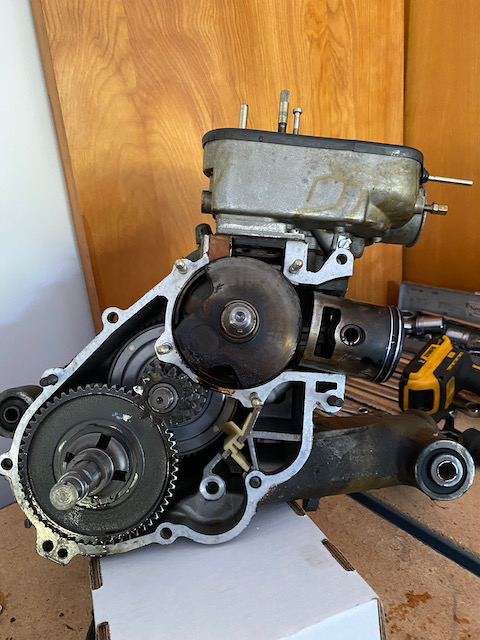
After knocking the crank out, the proximate cause of the failure is pretty evident. The big end of the rod that latches on to the crankshaft was locked solid. The flyside crankshaft bearing had also failed. I had to do a double take when I was examining the new bearings, as the new flyside crankshaft bearing looked different from what I had just hammered out of the case.

The old bearing on the right left its inner race on the old crankshaft. The clutch side crankshaft bearing was fine. It was ball bearing, not a “needles in rubber” bearing, and spins freely. What happened that these other bearing failed? Lack of lubrication is the obvious, but again, this is how two strokes are weird.
This scooter has an oil injection system. A pump driven by gears off the crankshaft pulls oil from a reservoir under the seat and into the carb. It get mixed and dumped into the combustion chamber and burns and lubricates the crankshaft, piston, and all the other goodies. In this engine, this did not happen. I checked the oil pump mechanism and it spun freely.
My thought is that when I tried to get this scooter running a while back, I cleaned the carburetor and the gas tank, and filled the oil tank. I gave it some kicks, and it ran for a while, but then didn’t. I’m thinking that that the old didn’t get pumped up to the carb before it started running just on the gasoline. So it revved, then locked up. Some scooter engine builders on Youtube run a premix of oil and gas in the tank to make sure everything gets well oiled on initial start up. Which is what I’ll do, as well as insure that the oil flows freely from tank to the carb and make sure the line is without kinks or blockage.
This sorting of the lubrication serves as a reminder that no matter how straight forward, light, and elegant the function of a two stroke motor is, it is incredibly filthy. I’ve been reading A. Graham Bell’s Two Stroke Performance Tuning. Much of it is significantly over my head, and irrelevant to the task at hand. I read it to find out what is important, and how the engines fail. It describes the art of carving out the ports and channels within the engine to encourage the air and fuel and oil to flow and explode and lubricate in the ideal manner, and the practice of chamfering and honing the rough edges to speed the flow, and rely on the shockwaves created by the explosions to excavate the exhaust and squeeze yet still more power. It all seems very craftsman, elegant, this carving and honing by hand while working in a very simple framework, especially in this engine. It has not cooling system (just some fins), no cams, rockers, or even oil splashing around, just old dinosaurs in, power out, ring-ding-ding.
But the smoke. Two strokes burn oil by design, the primary reason the design was abandoned forty years ago. Does my Zero balance the limited use of the scooter? Can I have it for fun, just a little bit, before the world ends?


 The One In Five